Showing posts with label africa. Show all posts

Monday, October 17, 2011

So, Rush Limbaugh Supports the Lord's Resistance Army

In a spectacular example of supreme dicketry, Rush Limbaugh openly criticized Obama's decision to send 100 troops to Uganda as support for the continued hunt for Joseph Kony, leader of the Lord's Resistance Army. Rush believes that the LRA are Christians fighting Muslims in Sudan, fighting to end the oppression of Ugandans and of gross violations of human rights - the LRA's "objectives", which naturally should be taken at face value. At the end of the transcript someone apparently informed Rush that the LRA is accused of "really bad stuff", such as child kidnapping, torture and murder, but all Rush knows is that "we got a hundred troops being sent over there to fight these guys -- and they claim to be Christians."

FYI, the official name of North Korea is the Democratic People's Republic of North Korea, but that doesn't mean the country is democratic. Same goes for the Lord's Resistance Army, which has terrorized northern Uganda for over 20 years. Attacks there have diminished, but only because the LRA has moved to the CAR and eastern DRC, with massacres happening there despite the presence of the largest humanitarian force on the world (MONUC). I don't know yet how to feel about 100 US troops in Uganda to help the search for Kony - it hasn't worked before and is likely that Kony isn't in Uganda, where the majority view is he should be granted amnesty so the whole ordeal can be dealt with locally, without the ICC - but I do know how I feel about hateful ignorance.

Maybe try Google next time, Rush, before you shit out of your mouth again.

Saturday, July 9, 2011

Welcome to the World, South Sudan!


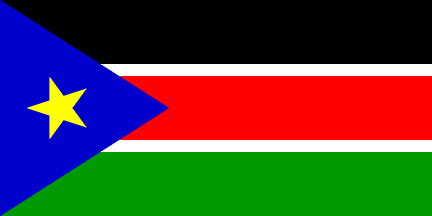
There is a new nation today: South Sudan, whose inhabitants voted in January to secede and become a separate nation, is officially independent today, June 9 2011. The flag has five colors: black representing the people and oil; red for the bloody cost of independence; green for the fertile land; blue for the Nile; and a golden star, symbolizing the (possible) wealth of the new nation. I met a Sudanese - South Sudanese - man today and he, understandably, is massively excited. Of course there are mountains of problems already facing the new government and the people of South Sudan, but we can turn to that tomorrow. For now, join with in celebrating the birth of a new nation.

Saturday, March 19, 2011

Catching Up

The close-call heart attack I had this morning was quickly remedied: Blogger kindly restored my cooking blog after I wrote to them that I had no idea why it would have been removed (because I didn't, though I suspected it was somehow related to the hacking of my gmail account) and shortly thereafter Cooking The Globe was back online with additional site moderation. Yay!

In other news, I have been unfortunately slack in keeping up-to-date with the news, be it international, local or personal. I blame it on the stresses of moving and relocating (which is legitimate enough: last weekend was the first time in two months Seth and I didn't have to go anywhere. I felt guilty not doing anything.) I also have no idea how to comment on the plethora of shit going on in the world currently so I will do what so many Americans do and simply ignore it. Weee, now life is simple!

Oh, except I am still writhing in pity and self-doubt as I attempt to write cover letters for potential jobs. I have finally written two sentences describing that I am, indeed, awesome; now I just two paragraphs detailing that assertion (nay: fact.) My lack of faith in my abilities amazes not only me, but my husband as well. Woe is me, I know.

On a positive note I have been learning Austin streets through the age-old tactic of driving around and getting lost; my kitty is adorable and will stick his face in mine in the morning, meowing, until I pet him - yes, that is adorable rather than annoying; and my friend Kerry and I solidified our undying devotion to the movie Showgirls with tattoos. Our love is eternal.


Pretty good silhouette on our legs, eh?

And there it is. Damn, I currently miss Uganda (and Africa in general) something fierce right now, though unsurprisingly, not Kuwait. Hopefully Seth and I will be able to make enough money to be able to travel a bit (albeit not at frequently as before.) Of course, I also hope I will get a job in the (near) future that will pay me to travel around the globe. How can I cover it without visiting it? There, I just gave myself a third excuse. I should add that talent to my list of awesomeness in those cover letters.

HIRE ME!

Sunday, January 30, 2011

On Cell Phones and Conflict Minerals

Last week I read a post in Texas in Africa (naming, shaming & measuring) concerning the Enough Project's monitoring and ranking of electronics companies making an effort to create a conflict-free mining sector in the Congo. When finished I silently cheered, not because of the rankings or the Enough Project's efforts, but rather because I agree with Texas in Africa that the effort is largely futile. I normally remain quiet on the issue because I have felt guilty about my opinion, as though it made me a bad Africanist or only quasi-liberal. In Uganda I was often with good-intentioned volunteers or know-it-all travelers and it was easier to say nothing rather than contradict their grandiose statements; cowardly, I know.

But the idea of conflict-free cell phones (and electronics in general) is dubious and largely a display of American arrogance. According to John Prendergast of the Enough Project, "[a]merican consumers have enormous leverage over the companies from which we purchase our electronics." Furthermore, Americans "we need to use our considerable market muscle to demand evidence from companies such as Apple, Nokia, Hewlett Packard, and Nintendo that their products do not contain conflict minerals." Inspiring demands, but I don't believe that Americans choosing conflict-free electronics will affect the crisis in the Congo, mainly for two reasons.

American consumers cannot make enough demand for electronics companies to offer only conflict-free products; American and Canadian and European consumers combined cannot make enough demand. What they can do, however, is demand that conflict-free products be offered to them. This does not stop the exploitation of minerals in the Congo; it does not stop women and girls from being raped. It allows the Western consumer to ease their conscience about the suffering of others by believing that at least their cell phone did not rape someone. A balm is not a cure. Just because Americans may buy conflict-free products does not mean those same products are offered in Asia, the Middle East or Africa itself and it certainly does not mean that fighting over control of eastern Congo will end; there is more to the conflict than minerals.

The fact that President Kabila (of the DRC) placed a ban on the export of minerals last September yet violence continues makes it clear that there is more to the conflict (in the Congo) than minerals.Tension (read: fighting) between autochthonous and foreign groups over territory; lack of state control leading to fighting for local control; invasions of foreign forces, though not exclusively the Rwandan and Ugandan armies: the Lord's Resistance Army remains in threat in the Congo, attacking villages, abducting children and killing indiscriminately. And those are only a few issues of a conflict so complex that the balance of powers changes if you look away for just a moment. I can understand the desire to boil down the issues to something as clear-cut as mineral (and human) exploitation, but the Congo defies such attempts at simplicity. Furthermore, as Laura at TiA points out, even if companies do comply with attempts to obtain conflict-free minerals, there is no definite way to ascertain whether or not those minerals actually are conflict-free.

"The electronics companies are powerful actors in their supply chains. If they show leadership, they can fundamentally change the way these minerals are bought and sold, ensuring that the minerals don’t contribute to armed conflict and the continuation of the worst violence against women and girls in the world." (Enough Project) Maybe, but probably not. Besides finding it incredibly disingenuous to make a direct connection between systematic rape in the Congo and electronics - and rather offensive to rape victims - the purpose of pushing for conflict-free minerals is to shame consumers rather than change the situation in Congo, with the result that consumers may buy new products while the situation in Congo remains the same. I understand the desire to for effective action, but wanting a plan to work does not ensure it will.


Not to seem negative for grassroots activism (though I do not consider the Enough Project grassroots, at least not anymore), I do applaud electronics for listening to consumer demands and attempting to obtain and offer conflict-free materials. Conscientious conglomerates can not be bad thing. I only want people to understand that being conscientious is not the ultimate solution to Congo's problems. To that end, I encourage everyone to read more about the Congo, the conflict and its myriad causes and complications, and the work being done on the ground to make the area safe for all inhabitants.

Texas in Africa
Congo Siasa
Heal Africa
HRW Congo
allAfrica.com


Africa's World War, Gerard Prunier
The Congo Wars: Conflict, Myth and Reality, Thomas Turner
In the Footsteps of Mr. Kurtz, Michela Wong
The Dynamics of Violence in Central Africa, Rene Lemarchand

Wednesday, January 19, 2011

South Sudan Well on the Way to Independence

At the beginning of polling there had been fears of voter intimidation and violence, but the vote for independence of south Sudan was largely "peaceful and credible", with 95% voter turnout and 96% supporting succession and, so it seems, with Khartoum and Bashir fully supporting the southern decision for independence. Though media attention has turned to the uprising and subsequent establishment of a new government in Tunisia, the Sudan issue is neither resolved nor by any means over; it is has merely reached a checkpoint.

While George Clooney and his minions spent the week in Juba monitoring the voting process in order to point out any possible genocides-in-action (despite the inherent futility in the endeavor - but that is the subject for a genocide post, coming soon!), the time for monitoring will be in July, when the referendum takes effect and the status of southerners in the north (and vice versa) becomes uncertain. Or when (and if) the oil-rich Abyei district votes for succession of independence. Or if Darfur rebels, recently expelled from southern Sudan in an attempt to appease Khartoum, will now view the south as much of an enemy as the north. Or is opposition leaders in the north continue to call for reform and are continually silenced through arrests.

And those are only external possibilities of violence: in the various articles covering the vote last week I read one in which southern Sudanese believe a independent South Sudan will better protect them from the Lord's Resistance Army. The LRA has used Sudan as a base of operations for years and since at least 2005 has perpetrated attacks on Sudanase living in the south. Khartoum stands accused of supporting the LRA, especially during the north-south civil war in Sudan (to effectively weaken the south.) The general belief is that with Khartoum no longer in control of the south, the new government will be better able to protect its citizens from invasions and raids.

My worry - and I am sure I not the only one, Western, African, Sudanese, what-have-you - is that a new South Sudan will not be able to immediately assuage the concerns of southern Sudanese. Al-Bashir himself, in a non-pedantic, honest assessment, pointed out that the initial stages of countryhood will be rough and uncertain for South Sudan. Being an American in the age of Obama, I know how fickle a population can be, especially when demands are not immediately answered. While I hope the government of the new South Sudan will diligently fulfill the hopes and allay the fears of its populace, I also hope that populace will be understanding during the grace period any new country needs. It remains to be seen, but as long as an independent South Sudan remains true to the southern Sudanese our hopes can remain positive.

Saturday, January 8, 2011

Sudan Prepared for Referendum Vote

Tomorrow balloting begins on the referendum for southern Sudan independence. The process is will take 7 days and 60% is the percentage of "yes" votes needed to determine whether or not southern Sudan will become its own country. There have been concerns over security and the willingness of Khartoum to accept a possible yes for independence, but President al-Bashir visited Juba on January 4 and pledged to honor the outcome of the ballot and to work closely with the south on post-referendum concerns, such as whether north or south will control the oil-rich district of Abyei.  In face, Abyei faces its own referendum to determine its boundaries and future status in Sudan - north, south or unified. Oil is Sudan's main export and main contributor to the country's GDP; which side will benefit from this wealth?

The coming week is sure to be tense, but Covering the Globe hopes and believes that the balloting will occur will relatively little violence; events following the vote, however, may not be. Will Sudan remain united yet face renewed conflict from detractors in the south? What will happen to Darfur rebels if southern Sudan splits, yet retain positive diplomatic relations with Khartoum? Darfur rebels were recently expelled from southern Sudan in order to appease the north - in what way will separation affect the ongoing conflict in Darfur?

This sounds horrible, but this event is damn exciting; literally, it's quite historic. I'll keep a close eye on the situation and keep you informed as to results. You can also check out allAfrica.com for up-to-date information.

Wednesday, November 10, 2010

Catching Up with the News

Some recent news out of Africa and elsewhere:


Osama bin Laden and the Sahel: From Al Jazeera, on how bin Laden has internationalized the situation in the Sahel (Mauritania, Mali, Niger, but can also include Burkina Faso, Senegal and even Morocco) with video messages supporting kidnappings and condemning Western influence in the region, while the European Council has attempted discretion over the matter. The "situation" refers to the kidnapping a French national in July and the nine hostages currently being held by Al Qaeda in the Islamic Mahgreb (AQIM), a creation of the Algerian DRS, a strong "terrorist" influence in the region. I can't go into details because I admit a high degree of ignorance concerning the Sahel in particular and North/ West African in general - it's not my area - but I recommend it because one, it's a reminder of just how large Africa is that a situation involving several African nations and France is considered "obscure" and two, it's healthy to have some understanding of the current events, obscure or not. For background on AQIM, the hostage crisis and why the European Council is involved in what originally were France's solitary actions, read the articles here, here and here.

Facebook, You're So Naughty: an employee was fired after posting disparaging remarks about her supervisor on her Facebook page, a post which prompted additional caustic remarks from co-workers. The employee is claiming unlawful termination. Will be interesting to see how this plays out and how much control companies will lose (or gain!) over their employees.

And check out Scocca on Slate: funny, relevant, biting - everything I wish I could be.

Sunday, November 7, 2010

Boycott Botswana's Diamonds . . . ?


There is an article on allAfrica.com about the call from Survival International to boycott Botswana's diamond industry. According to the SI, the government of Botswana is attempting to starve out Bushmen in the Kalahari region by by halting distribution of water throughout the area as well as removing pumps to extract water and banning the re-opening of a closed borehole which provided water to the majority of Bushmen community. In addition to boycotting the country's diamonds, SI is also calling for a boycott of Botswana tourism - safaris are the main draw in Botswana - until the Botswana High Court rules in favor of the Bushman and the right to access water and (live on their ancestral lands.)

This article caught my eye mainly because Botswana is known as a provider of "legitimate diamonds" (as opposed to "blood diamonds") and the government has been lauded for raising the living standards of its citizens because of diamond revenue. Though Survival International's website is fairly vague about how it works and I am not sure of its legitimacy, the claim of the Bushmen is valid, as is any international outcry supporting it. Yet I wonder how much attention this will get in international media as it is a crime with no bloodshed where the government in question is ultimately helping the majority of its citizens with education, health care and the like? Or will those organizations dedicated to promoting conflict-free diamonds take up the Bushmen cause as well?

On a related note: how effective are campaigns against so-called blood diamonds? The diamond industry is a global monster and I can't imagine it can be brought by a few opposition campaigns. Plus the fervor over diamonds seems to have died down during the past couple of years. I'll look into it and let you know what I find.

Photo courtesy M. Cowan, Survival International

Wednesday, August 25, 2010

Big Things Comin'

Over the past two months I have become so much better at regularly posting (until this past week; oops) that it has made me reassess why I even have a blog.  What do I want to accomplish?  Whom am I trying to attract?  In other words, where is this going?  How many italicized question words can I use?  (Five.)  I am having trouble managing my life, but I am sure I can micromanage the hell out of it!

That said (written), Seth and I are heading to Cyprus for the next week (tough, I know.)  I will be teka, teka (thinking, thinking) and promise that, come September, I - and this blog - will have definite focus, a purpose! Meaning: more than just a personal journal.  I hope.

I have several things on my mind but have been unable (or unwilling) to put them into coherent paragraphs, but feast your mind on these tidbits:

--> There is a large wage gap here between Westerners and Easterners.  I understand that the exchange rate of Kuwaiti Dinars into whatever local Eastern currency (Indian rupees, for example) highly favors the local currency - that is, these employees are earning a wage largely unattainable in their home country.  However, there is a tendency by Westerners to treat Easterners as lesser people, yet not feel guilty about such actions because said Easterners are so much better off here than they would be in their own country.  I can't get behind that kind of skewed logic.

--> According to my Indian cookbook, "Vindaloo is notorious for being hot and spicy."  The recipe calls for 4 dried chilies, which you then pound or grind into a powder.  Not having dried chilies, I decided 2 teaspoons of chili powder would be the same (note: it is not.)  Combined with the 4 fresh chilies you also add (with other spices, of course) what resulted was a powerful inferno.  I had sweat pooling on my eyelids.  That shit was so hot (yet also delicious) that my endorphins were increased to the point that I felt like I was on uppers.

--> While my loving husband has assured me that I don't need to find a job right now; I can focus on writing and whatnot; he just wants me to be happy; I personally want to make some money.  I want to contribute!  But I become paralyzed when I have to actually apply, envisioning the possible rejections that follow.  Nothing to fear but fear itself - and multiple job denials.

--> Pay attention when chopping or you will slice off the top of your thumb.  Oops.

It's looks like my thumb's brain is poking through.

--> There are so many actors involved in the DRC that I feel as though I am trying to figure out a puzzle.

Bang.

Sunday, August 8, 2010

Rwandan Elections


Rwandan elections are tomorrow. I don't think anyone, including opposition leaders, doubt Kagame's victory or suspect violence of any significance, but it will be interesting to see the margin of victory for the RPF. For coverage and editorials, please refer to the following:

http://allafrica.com/

http://kigaliwire.com/

http://www.independent.co.ug/


http://congosiasa.blogspot.com/


http://texasinafrica.blogspot.com/

Saturday, July 31, 2010

Ogling the Poor Is Never Cool

I recently read this article by Jina Moore about poverty tourism, making my post of a few days ago seem relevant enough, if a year late. Moore believes that critiques of such tours have less to do with exploiting the poor, but rather discomfort with "our own economic power and our concerns about using it ethically." She contends that tourists have no issue with exploiting the rich by viewing their, such as touring Windsor castle, but I strongly disagree with the comparison. A tour of Windsor castle or the White House are sterile and static experiences, polished facades presented to the public devoid of actual "living". There are no people and the point of the tour isn't the people, but rather the opulence of where and how they live. Poverty tourism, on the other hand, while also relying on the "where" and "how", relies on displaying the people, the poor, themselves. you don't tour an empty village with a guide showing you a shack families may sleep in; you walk around their very lives, ogling at the misfortune.

The most telling difference, however, is the implicit idea that experiencing the world of the poor will make you, the viewer, a better person. There's no mention in any brochure or advertisement - that's why it's implicit - but by talking to individuals who vacation in Africa, who go on "village walks", who specifically request visiting rural schools, it's there. And that's why it's exploitative. My slum tour is certainly no Millennium Village - that's actually a great project - but, willingly or unwillingly, no person should be part of a zoo.

Saturday, July 17, 2010

Continuing Effects


I am preparing my next post on genocide theory, but while waiting for that let's consider the continuing effects of genocide:

The vice-president of Rwanda's Green Party was found dead just a few days ago. The police claim he was robbed, but as his wallet and money were not taken from him and he was found "nearly beheaded", it's more likely he was targeted as an opposition figure. This happened approximately one month after another opposition figure, Faustin Kayumba Nyamwasa, was shot in Johannesburg, and also a month after the journalist who accused the Rwandan government of attempting to assassinate Nyamwasa was himself shot and killed.

So Rwanda is perhaps not as safe as it is touted to be, but what does this have to do with genocide? Everything, actually: Paul Kagame endlessly uses the Rwandan genocide as an excuse for any actions the government and army take that are considered questionable or illegal. This includes invading DRC in order to plunder its mineral wealth; closing newspapers and blocking opposition parties from registering for the presidential elections; and assassinating opposition members. But before you speak up and openly accuse Kagame of such oppressive practices, remember that he and the RPF liberated Rwanda from a devastating and particularly brutal genocide while the rest of world looked away.

However, considering that Kagame and the RPF invaded Rwanda in order to take control of the government and the country - and once the genocide began, continued with this plan, clearly avoiding areas where massacres were occurring - how long can we be expected to turn on our backs on such obvious displays of fascism? Taking power by force is one thing - of course the US can't be too critical about that - but sixteen years later it's time to let the political process normalize.

And stop guilt-tripping people who dare criticize your actions - the honeymoon ended long ago.

Image courtesy www.altnation.com

Tuesday, July 13, 2010

Bombs and the Horn

With at least 74 people dead following bomb attacks at two locations in Kampala, Somalia is receiving renewed attention (thanks to Al Shabab claiming responsibility) - but to what end? It is unlikely that the attacks will encourage African nations (especially Uganda) to remove troops from Somalia - increased engagement in more likely - but is that the best solution for peace and a viable government in Somalia?

What does it take to remove the monikers of "failed state" and "terrorist haven" from Somalia? More diplomatic attention, especially from Arab states? Greater focus on clan coalitions? The past 20 years of conflict prove that there is no easy answer (considering how complicated the situation is) but surely there's a better way than simply try to keep the fighting - and refugees - from spilling over into neighboring countries?

So many questions, but all pointing in the same direction: the need for a secure and politically viable Horn. Without that, how can we expect safety and development in East Africa - or all of Africa, for that matter?